GitOps Implementation Framework for Spring Boot Microservices

· 9 min read
Sanjoy Kumar Malik
Solution/Software Architect & Tech Evangelist
GitOps Implementation Framework for Spring Boot Microservices

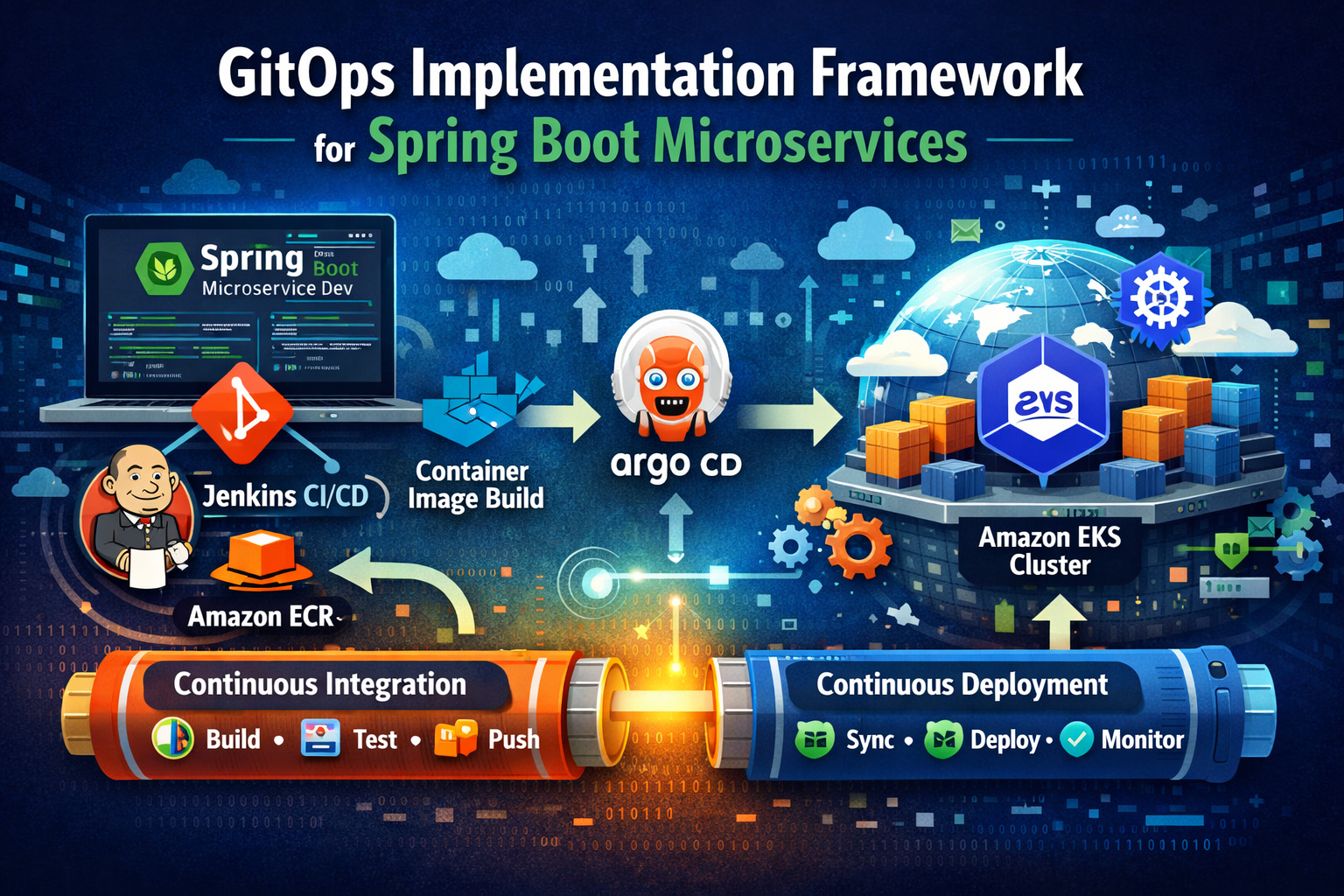
In modern cloud-native engineering, the ability to ship software reliably and often is essential. GitOps is the paradigm that enables this by making Git the single source of truth for both application code and deployment configurations. When developers push code to Git, a declarative pipeline ensures the corresponding changes are built, tested, and deployed to production — automatically and safely.

GitOps is a cloud-native deployment methodology that uses Git as the single source of truth for both application and infrastructure configurations. All desired state — container images, Kubernetes manifests, Helm charts — lives in Git. A GitOps controller (e.g., Argo CD) continuously reconciles the live cluster state with the desired state in Git.

This article presents a generic, reusable GitOps implementation framework tailored for Spring Boot microservices on Kubernetes, with a detailed end-to-end example using an Order Service deployed to Amazon EKS. We use industry-standard tools:

  • Jenkins for CI (Continuous Integration)
  • Amazon ECR as Container Registry
  • Argo CD as the GitOps CD (Continuous Deployment) engine
  • Amazon EKS as the Kubernetes runtime

The implementation embodies industry best practices and leverages real-world adoption patterns reported for GitOps and Argo CD. According to recent surveys, GitOps adoption has soared with primary incentives including automation, configuration consistency, and auditability and Argo CD is now a mainstream choice for Kubernetes environments.

The article is divided into two parts:

Part 1: A reusable, generic GitOps framework applicable across domains
Part 2: Applying the Framework to an Example Spring Boot Microservice


GitOps and DevOps Explained - Overlap, Distinction, and Use Cases

· 11 min read
Sanjoy Kumar Malik
Solution/Software Architect & Tech Evangelist
GitOps and DevOps Explained - Overlap, Distinction, and Use Cases

In modern software engineering, organizations continually seek ways to accelerate delivery, improve reliability, and strengthen collaboration between development and operations. Two paradigms frequently discussed in this context are DevOps and GitOps. While they share core goals, they differ in scope, workflows, toolchains, and operational models. Understanding both their alignment and differences helps teams adopt the right practices for their environments and objectives.

Defining DevOps and GitOps

DevOps represents a cultural and operational philosophy that unifies software development and IT operations to improve software delivery velocity and quality. It emphasizes automation, cross-functional collaboration, continuous integration/continuous delivery (CI/CD), and feedback loops across the entire software lifecycle. DevOps spans planning, building, testing, deployment, and monitoring, and is platform-agnostic with broad applicability across cloud-native, hybrid, and traditional applications.

GitOps, by contrast, is a more focused operational model and automation technique. It uses Git as the single source of truth (SSoT) for both application code and infrastructure configurations. Changes are made through commits and pull requests, with automated agents (e.g., Argo CD, Flux) reconciling the declared state in Git with the live environment. GitOps emphasizes declarative infrastructure and continuous reconciliation, especially in Kubernetes and cloud-native ecosystems.

Microservices and DevOps - Better together

· 6 min read
Sanjoy Kumar Malik
Solution/Software Architect & Tech Evangelist
Microservices and DevOps - Better together

Microservices and DevOps are often discussed as independent evolutions in modern software delivery. In practice, they are deeply interdependent. Microservices without DevOps tend to collapse under operational complexity. DevOps without microservices often struggles to achieve its full potential of speed, autonomy, and scalability.

When implemented together microservices and DevOps form a delivery model that enables rapid change, high reliability, and sustainable engineering velocity.

This article explains why they are better together and outlines concrete best practices for integrating DevOps with microservices at scale.

DevOps vs. Platform Engineering vs. SRE - Differences Explained

· 5 min read
Sanjoy Kumar Malik
Solution/Software Architect & Tech Evangelist
DevOps vs. Platform Engineering vs. SRE - Differences Explained

Modern software organisations increasingly rely on three disciplines that overlap but are distinct: DevOps, Site Reliability Engineering (SRE), and Platform Engineering. While all three aim to increase efficiency, automation, and reliability in delivering software, they differ in focus, scope, responsibilities, metrics, and organisational expectations.

This guide clarifies the differences across several practical dimensions to help you navigate these roles effectively.

Core Definitions: What Each Discipline Means

DevOps

  • A cultural movement and set of practices whose goal is to break down silos between Development and Operations, enabling faster, higher-quality software delivery through collaboration, automation (CI/CD), shared accountability, and iterative improvement.
  • It is fundamentally about culture and process rather than a specific team or organisation structure.

Site Reliability Engineering (SRE)

  • A software engineering discipline that applies software engineering practices to operations problems with the core purpose of ensuring reliability, uptime, scalability, and performance of production systems.
  • Originally formalised at Google, SRE uses engineering approaches (automation, monitoring, SLOs/SLIs, error budgets) to run systems reliably at scale.

Platform Engineering

  • An engineering discipline focused on building and maintaining internal platforms, tooling, frameworks, and self-service capabilities that accelerate developer productivity and standardise infrastructure.
  • Platform Engineering treats the set of internal tools as a product for developers.
Simply put:

"Devops is the why, SRE is how to ensure reliability, and platform engineering is how to scale it and make it easy for everyone.” - InfoWorld

Primary Focus and Objectives

The Four DORA Metrics That Define Modern Software Delivery

· 15 min read
Sanjoy Kumar Malik
Solution/Software Architect & Tech Evangelist
The Four DORA Metrics That Define Modern Software Delivery

Introduction: Why Measuring Software Delivery Is Hard

For decades, the software engineering industry has grappled with a persistent and often frustrating challenge: how do you accurately measure productivity and effectiveness in a domain built on creativity, problem-solving, and constant evolution? Historically, attempts to quantify engineering output have often fallen short, leading to misguided strategies and unmet expectations.

We have seen countless organizations cling to traditional metrics that, while seemingly logical, ultimately fail to paint a complete or accurate picture. Metrics like "lines of code written" are easily gamed and bear little correlation to actual value delivered. "Developer utilization rates" often encourage busyness over impact, fostering a culture where looking busy is prioritized over shipping high-quality software. Even "story points velocity," a staple of agile methodologies, can become an internal-facing measure that, when weaponized, drives teams to inflate estimates or sacrifice quality for perceived speed, rather than focusing on the actual outcomes for users and the business.

The fundamental flaw in these traditional approaches is their focus on activity or output rather than outcomes. Within the complex, adaptive nature of software delivery, simply tracking what engineers do does not tell you if what they are doing is actually effective, valuable, or sustainable. We need a shift in perspective, moving from internal process metrics to external, outcome-oriented delivery metrics that reflect the health and performance of the entire software delivery system.

This is where DORA enters the conversation. The DevOps Research and Assessment (DORA) group has revolutionized how we think about software delivery performance, providing a robust, research-backed framework that has fundamentally reshaped industry discourse. This article will delve into the four core DORA metrics, explaining what they measure, why they matter, and how they work in concert to define modern software delivery success. We will explore their power to foster better conversations, drive meaningful improvements, and align engineering efforts with business objectives.

What this article will not cover are the intricacies of setting up DORA metric collection tools, nor will it prescribe specific technical solutions. Our focus is on the foundational understanding and strategic application of the metrics themselves.

Decision Framework - Choosing Between Managed vs Self-Hosted CI/CD Solutions

· 15 min read
Sanjoy Kumar Malik
Solution/Software Architect & Tech Evangelist
Decision Framework - Choosing Between Managed vs Self-Hosted CI/CD Solutions

Continuous Integration and Continuous Delivery (CI/CD) systems sit at the center of modern software delivery. They are not merely automation tools; they are strategic delivery platforms that directly influence deployment frequency, lead time for changes, operational stability, and developer productivity.

As organizations scale—adding more teams, services, environments, and compliance requirements—the question inevitably arises: Should we rely on a managed CI/CD service, or should we build and operate our own self-hosted CI/CD platform?

This decision is deceptively simple on the surface and deeply consequential in practice. It affects:

  • Engineering velocity and autonomy
  • Platform team workload and operating costs
  • Security posture and compliance readiness
  • Long-term flexibility and vendor dependence

In most organizations, this decision is owned jointly by platform engineering teams, DevOps leaders, and senior technology leadership (CTO / VP Engineering). It is often revisited multiple times as the organization evolves.

Common failure modes include:

  • Choosing managed CI/CD too early, leading to hidden scale or customization constraints later
  • Choosing self-hosted CI/CD too early, creating unnecessary operational burden
  • Treating the decision as a tooling choice rather than a platform and operating-model decision

This article provides a structured decision framework to help engineering leaders make this choice deliberately, contextually, and defensibly.