
2 posts tagged with "gitops"

View All Tags

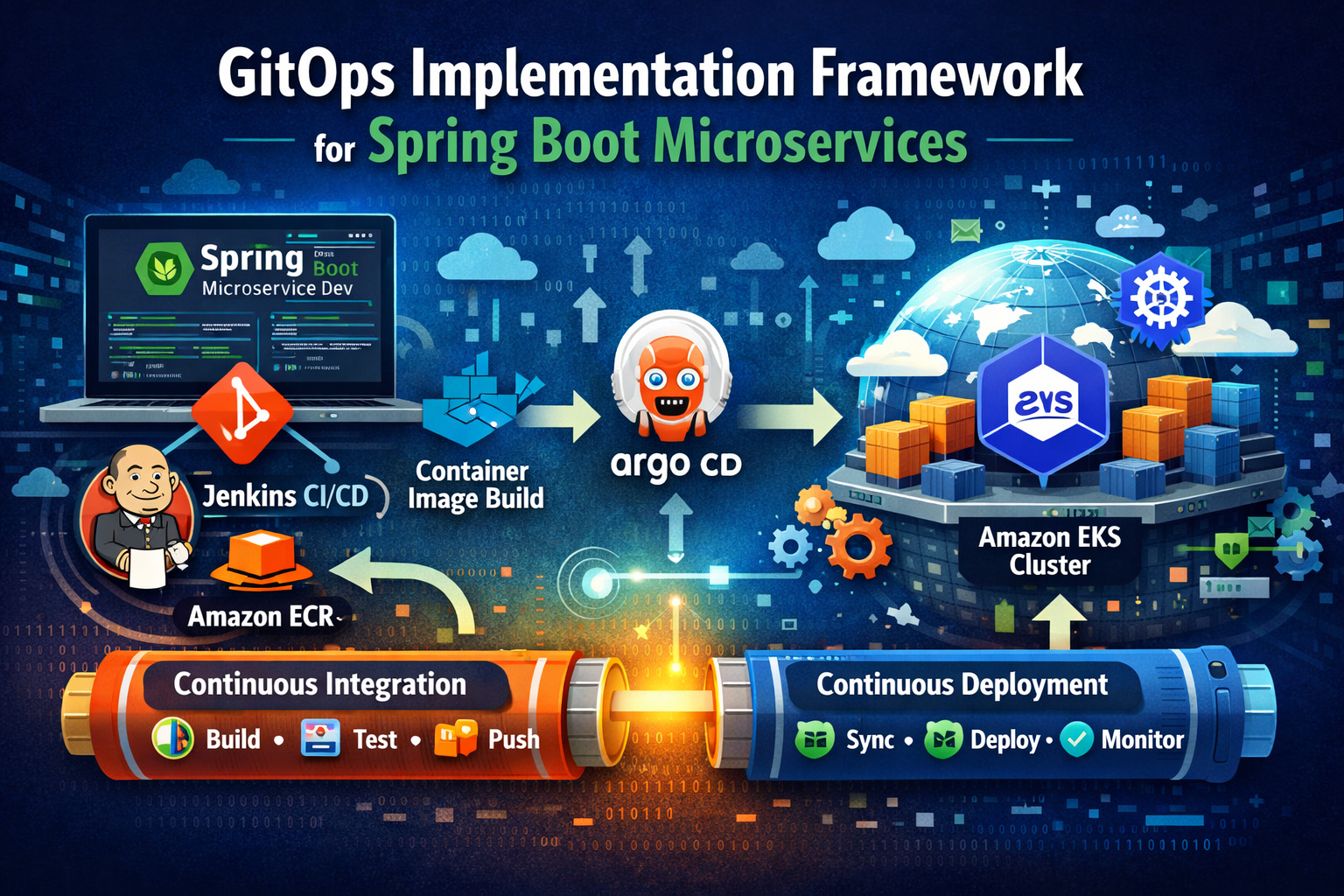
GitOps Implementation Framework for Spring Boot Microservices

· 9 min read
Sanjoy Kumar Malik
Solution/Software Architect & Tech Evangelist
GitOps Implementation Framework for Spring Boot Microservices

In modern cloud-native engineering, the ability to ship software reliably and often is essential. GitOps is the paradigm that enables this by making Git the single source of truth for both application code and deployment configurations. When developers push code to Git, a declarative pipeline ensures the corresponding changes are built, tested, and deployed to production — automatically and safely.

GitOps is a cloud-native deployment methodology that uses Git as the single source of truth for both application and infrastructure configurations. All desired state — container images, Kubernetes manifests, Helm charts — lives in Git. A GitOps controller (e.g., Argo CD) continuously reconciles the live cluster state with the desired state in Git.

This article presents a generic, reusable GitOps implementation framework tailored for Spring Boot microservices on Kubernetes, with a detailed end-to-end example using an Order Service deployed to Amazon EKS. We use industry-standard tools:

  • Jenkins for CI (Continuous Integration)
  • Amazon ECR as Container Registry
  • Argo CD as the GitOps CD (Continuous Deployment) engine
  • Amazon EKS as the Kubernetes runtime

The implementation embodies industry best practices and leverages real-world adoption patterns reported for GitOps and Argo CD. According to recent surveys, GitOps adoption has soared with primary incentives including automation, configuration consistency, and auditability and Argo CD is now a mainstream choice for Kubernetes environments.

The article is divided into two parts:

Part 1: A reusable, generic GitOps framework applicable across domains
Part 2: Applying the Framework to an Example Spring Boot Microservice

GitOps and DevOps Explained - Overlap, Distinction, and Use Cases

· 11 min read
Sanjoy Kumar Malik
Solution/Software Architect & Tech Evangelist
GitOps and DevOps Explained - Overlap, Distinction, and Use Cases

In modern software engineering, organizations continually seek ways to accelerate delivery, improve reliability, and strengthen collaboration between development and operations. Two paradigms frequently discussed in this context are DevOps and GitOps. While they share core goals, they differ in scope, workflows, toolchains, and operational models. Understanding both their alignment and differences helps teams adopt the right practices for their environments and objectives.

Defining DevOps and GitOps

DevOps represents a cultural and operational philosophy that unifies software development and IT operations to improve software delivery velocity and quality. It emphasizes automation, cross-functional collaboration, continuous integration/continuous delivery (CI/CD), and feedback loops across the entire software lifecycle. DevOps spans planning, building, testing, deployment, and monitoring, and is platform-agnostic with broad applicability across cloud-native, hybrid, and traditional applications.

GitOps, by contrast, is a more focused operational model and automation technique. It uses Git as the single source of truth (SSoT) for both application code and infrastructure configurations. Changes are made through commits and pull requests, with automated agents (e.g., Argo CD, Flux) reconciling the declared state in Git with the live environment. GitOps emphasizes declarative infrastructure and continuous reconciliation, especially in Kubernetes and cloud-native ecosystems.