Incident Response Lifecycle - From Detection to Resolution

In the complex, interconnected world of modern software, failures are not a matter of if, but when. From a user’s perspective, a system that is down, slow, or incorrect is a broken system, regardless of the underlying technicality. The manner in which an organization responds to these inevitable disruptions directly impacts its reputation, user trust, and ultimately, its bottom line. Ad-hoc, chaotic incident response is a recipe for disaster, leading to prolonged outages, exhausted teams, and a continuous cycle of firefighting.
The true cost of unmanaged or ad-hoc incident response extends far beyond immediate revenue loss. It erodes customer loyalty, introduces significant security vulnerabilities, and degrades employee morale. When engineers are constantly reacting to emergencies without a clear process, they burn out, make more mistakes, and have less time for proactive development and innovation. Incident response, therefore, must be viewed not merely as a reaction to failure, but as a core reliability capability – a systematic, well-oiled machine designed to minimize impact and maximize learning.
At scale, a lifecycle view of incident response is not just beneficial; it’s essential. As systems grow in complexity and teams expand, a shared understanding of roles, processes, and expected behaviors becomes critical. A well-defined incident response lifecycle provides this framework, guiding teams from the first whisper of a problem to the final implementation of preventative measures. It transforms chaos into controlled action, enabling organizations to not only survive incidents but to emerge stronger and more resilient from each one.
Scope and Operating Context
Before diving into the mechanics, it is crucial to define what an "incident" truly means within your organization. Broadly, an incident is an unplanned interruption to a service or a reduction in the quality of a service. This includes events that are not yet impacting users but have the potential to, as well as events that compromise data integrity or security.
Types of failures covered by a comprehensive incident response lifecycle typically include:
- Availability: The service is completely down or inaccessible.
- Latency: The service is responding too slowly, causing user frustration or timeouts.
- Correctness: The service is returning incorrect data or behaving unexpectedly, even if available.
- Security: Unauthorized access, data breaches, or vulnerabilities that compromise the system's integrity or confidentiality.
The assumptions about team maturity and tooling are also vital. This guide assumes a growing organization that recognizes the need for structured processes, likely utilizing a combination of monitoring tools (e.g., Prometheus, Datadog), alerting systems (e.g., PagerDuty, Opsgenie), communication platforms (e.g., Slack, Microsoft Teams), and incident management tools (e.g., JIRA Service Management, ServiceNow). The principles, however, are adaptable to various levels of maturity, with simpler toolchains for smaller teams and more sophisticated integrations for larger enterprises.
The Incident Response Lifecycle (Overview)
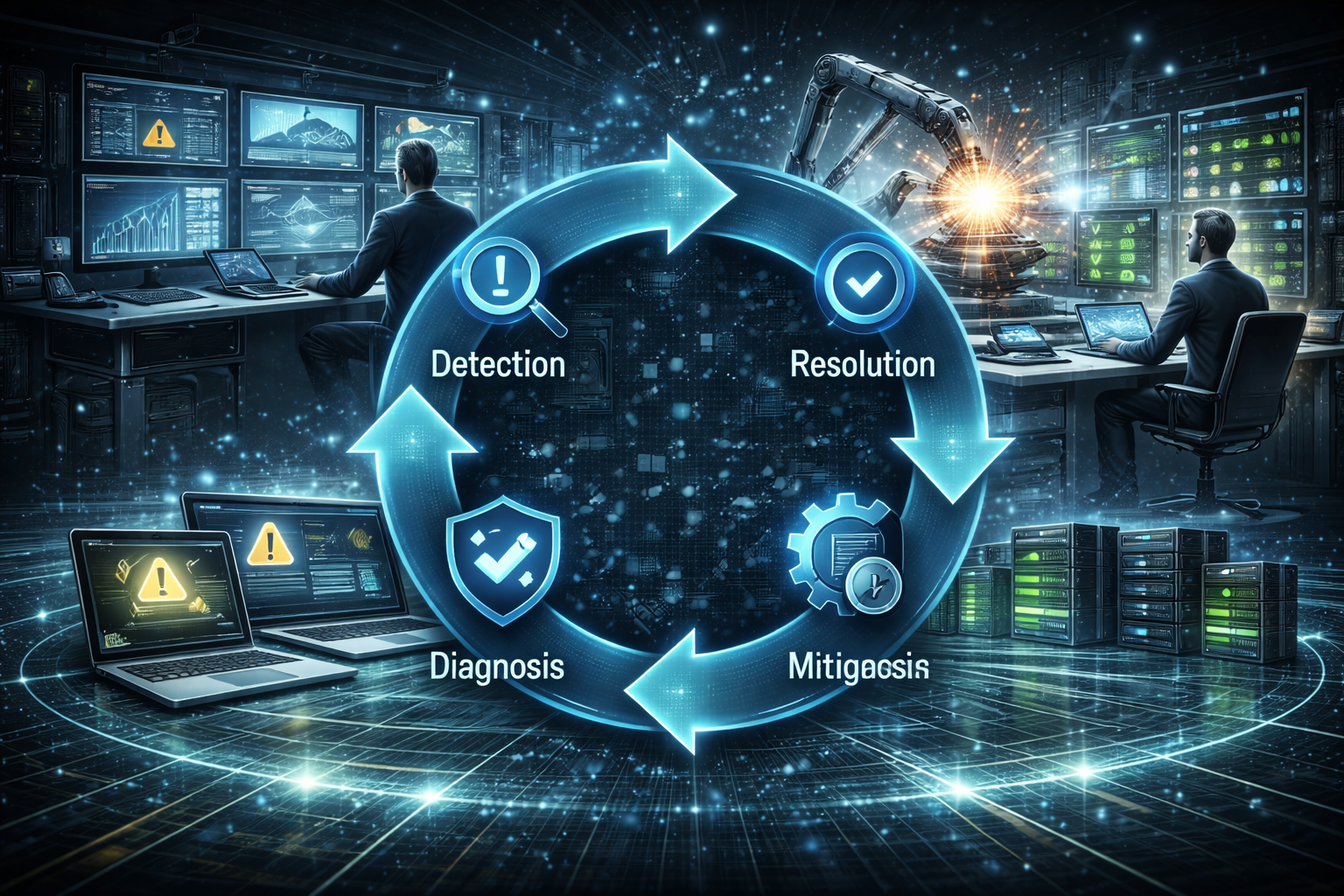
The incident response lifecycle is a continuous process, not a linear one. It’s characterized by a series of distinct phases, each with its own objectives and activities, all feeding back into a continuous improvement loop.
Here is a high-level overview of the phases:
- Detection: Identifying that a problem exists.
- Triage & Declaration: Assessing the severity and formalizing the incident.
- Mitigation & Containment: Stabilizing the system and preventing further impact.
- Resolution & Restoration: Fixing the underlying issue and returning to normal operation.
- Recovery & Normalization: Clearing backlogs and ensuring full stability.
- Post-Incident Learning & Improvement: Analyzing the incident to prevent recurrence.
This flow, from the initial detection of a problem to the ultimate learning and feedback into reliability improvements, is what transforms reactive firefighting into proactive reliability engineering.
Detection and Signal Validation
The first step in any incident is knowing that one is occurring. Effective detection hinges on robust monitoring and alerting. However, not all signals are created equal. Organizations often struggle with alert fatigue – a deluge of non-actionable alerts that desensitize responders and obscure critical issues.
Monitoring signals vs. noise: Focus on monitoring what truly matters: user experience. This means tracking key performance indicators (KPIs) like latency, error rates, and throughput from the perspective of your users. Infrastructure metrics (CPU usage, memory) are important for debugging but should primarily trigger alerts when they directly correlate with user-facing impact or breach predefined thresholds of acceptable service health.
Alert quality and SLO-driven detection: The most effective alerts are tied directly to Service Level Objectives (SLOs). An SLO defines an acceptable level of service. When a system deviates from its SLO (e.g., latency exceeding 200ms for 5% of requests over a 5-minute window), it should trigger a high-fidelity alert. These alerts are actionable, indicate real user impact, and provide context about the severity of the problem. Your alerting system should be designed to escalate these SLO-breaching events rapidly to the appropriate on-call teams.
Confirming real user impact: Upon receiving an alert, the immediate priority is to validate its authenticity and confirm real user impact. This might involve checking dashboards, logs, synthetic transactions, or even reaching out to a small subset of users if the issue is subtle. This validation step prevents false alarms from escalating into full-blown incidents, saving valuable engineering time and reducing unnecessary stress.
##Triage and Incident Declaration
Once a real issue with user impact is confirmed, the next crucial step is triage and formal incident declaration. This phase sets the stage for a structured response.
Severity classification: Incidents are not all created equal. A clear severity classification system is paramount for prioritizing resources and dictating communication protocols. A common classification might look like this:
- SEV-1 (Critical): Major outage, severe data loss, or significant security breach affecting a large number of users.
- SEV-2 (Major): Partial outage, degraded performance impacting a significant user base, or moderate data loss.
- SEV-3 (Minor): Localized impact, minor performance degradation, or potential future issues.
- SEV-4 (Informational): System anomaly that doesn’t currently impact users but warrants investigation.
The severity level determines the urgency of the response, the number of resources to be engaged, and the frequency and breadth of communication.
Ownership and incident commander assignment: For any incident beyond SEV-3, a dedicated Incident Commander (IC) should be assigned immediately. The IC is a single point of authority responsible for managing the incident response process, not necessarily fixing the technical problem. Their role is to facilitate, prioritize, and communicate, ensuring the right people are involved and the incident progresses efficiently. Clear ownership prevents confusion and ensures decisive action.
Initial communication and coordination: As soon as an incident is declared and classified, initial communication must begin. This typically involves:
- Creating a dedicated incident communication channel (e.g., a Slack channel, a bridge call).
- Sending initial notifications to relevant stakeholders (internal teams, leadership, potentially external customers if SEV-1).
- Establishing a single source of truth for updates (e.g., an incident tracking document or tool).
##Mitigation and Containment
With an incident declared and an IC in charge, the focus shifts to mitigation and containment – stabilizing the system and stopping the bleeding. This is often the most intense and time-sensitive phase.
Stabilizing the system: The primary goal here is to restore service or reduce impact as quickly as possible, even if it’s a temporary fix. This might involve:
- Rolling back recent deployments.
- Restarting services.
- Failing over to a redundant system.
- Disabling problematic features.
- Shifting traffic away from an unhealthy component.
The emphasis is on speed and impact reduction, not necessarily finding the ultimate root cause at this stage.
Short-term mitigations vs. permanent fixes: It's crucial to distinguish between a short-term mitigation that buys time and a permanent fix. During an active incident, prioritize mitigations that restore service fastest. The permanent fix, which might require more extensive testing or architectural changes, can often be deferred to a follow-up action item after the incident is resolved.
Decision-making under uncertainty: Incident response often involves making critical decisions with incomplete information under immense pressure. The Incident Commander plays a vital role in facilitating this. Encourage a culture where responders can propose solutions, test hypotheses rapidly, and communicate findings clearly. Psychological safety is critical here – teams must feel empowered to try reasonable solutions without fear of blame if an attempt doesn't immediately succeed.
Resolution and Service Restoration
Once the system has been stabilized through mitigation, the next step is to achieve full resolution and service restoration. Root cause correction: While mitigation focuses on the symptoms, resolution aims at addressing the underlying cause. This might involve:
- Deploying a hotfix.
- Reverting a configuration change that was identified as the culprit.
- Scaling up resources that were exhausted.
- Patching a newly discovered vulnerability.
The depth of root cause analysis during the active incident depends on its complexity and severity. For critical incidents, a full root cause may only be identified during the post-incident review, but enough must be found to confidently restore service. Verification of system health: Before declaring the incident resolved, thorough verification is essential. This includes:
- Checking all relevant monitoring dashboards.
- Performing end-to-end tests or synthetic transactions.
- Soliciting feedback from affected users or internal stakeholders.
- Ensuring error rates and latency are back within acceptable SLOs.
Never assume resolution; always verify.
Closing the active incident: Once verification confirms the service is fully restored and stable, the Incident Commander formally closes the active incident. This triggers final communication to stakeholders, informing them that the issue has been resolved. While the active phase concludes, the incident journey is not over.
Recovery and System Normalization
Resolution marks the end of the immediate crisis, but the recovery phase ensures that the system, and the team, fully return to a healthy state.
Clearing backlogs and secondary effects: Incidents often create secondary effects. For example:
- Queues might have built up (e.g., message queues, processing backlogs).
- Cache invalidations might be needed.
- Scheduled jobs might have failed and need reprocessing.
- Manual workarounds might need to be undone.
This phase focuses on systematically addressing these secondary impacts to prevent future issues or ensure data consistency.
Ensuring full operational stability: This involves ongoing monitoring of the "recovered" system for a period to ensure no lingering issues or unexpected side effects emerge. It’s a period of vigilance where teams confirm that the system is not just operational, but operating robustly and reliably.
Team recovery considerations: Incident response is taxing, especially for critical incidents. This phase also includes considering the well-being of the incident responders. Encourage breaks, provide support, and ensure that individuals have time to decompress and recover from the stress. Sustainable on-call rotations and debriefings that acknowledge the human element are crucial for long-term team health.
Post-Incident Learning and Improvement
This is arguably the most critical phase, transforming a negative event into a positive catalyst for growth. Without structured learning, incidents are doomed to repeat.
Blameless postmortems: The cornerstone of post-incident learning is the blameless postmortem. This is a detailed analysis of what happened, when, why, and what was done, conducted in an environment focused on understanding system failures, not individual shortcomings. The goal is to identify systemic weaknesses, process gaps, and opportunities for improvement.
Key elements of a blameless postmortem include:
- A detailed timeline of events.
- Identification of contributing factors (not just "the" root cause, as there are usually multiple factors).
- Analysis of detection, triage, mitigation, and communication effectiveness.
- A list of action items, assigned owners, and deadlines.
Identifying systemic contributors: During the postmortem, look beyond the immediate technical fault. Often, incidents are symptoms of deeper systemic issues such as:
- Insufficient testing.
- Lack of monitoring for specific failure modes.
- Poorly defined ownership.
- Technical debt.
- Inadequate documentation.
- Process gaps.
Feeding learnings back into monitoring, automation, and process: The output of the postmortem isn't just a document; it's a set of concrete action items. These should feed directly back into:
- Monitoring: Adding new alerts, improving existing ones, creating new dashboards.
- Automation: Automating manual recovery steps, building self-healing systems.
- Process: Refining incident response procedures, updating runbooks, improving communication protocols.
- Architecture: Addressing technical debt, improving system resilience.
This feedback loop is what makes the incident response lifecycle a powerful engine for continuous reliability improvement.
Roles and Responsibilities Across the Lifecycle
Clear roles are paramount for effective incident response, preventing confusion and ensuring efficient action.
-
Incident Commander (IC): The conductor of the orchestra. Owns the incident from declaration to resolution. Responsible for overall coordination, communication, setting priorities, and ensuring the right people are engaged. Does not typically perform technical work.
-
Responders and Subject-Matter Experts (SMEs): The technical problem solvers. These are the engineers with deep knowledge of the affected systems. They diagnose issues, implement mitigations, and propose resolutions under the guidance of the IC.
-
Communications Lead (Comms Lead): A dedicated role, especially for SEV-1/2 incidents. Responsible for crafting and disseminating internal and external communications, ensuring stakeholders are consistently updated.
-
Stakeholder Roles: Various internal teams (e.g., customer support, product, legal) and external customers who need to be informed of the incident status. Their role is primarily to consume information and provide feedback if needed.
-
Scribe/Documentation Lead: Documents the incident timeline, actions taken, and key decisions. This is crucial for the postmortem process.
For smaller teams, individuals might wear multiple hats, but the functions of these roles must still be covered.
Measuring Incident Response Effectiveness
You can't improve what you don't measure. Key metrics provide insights into the health of your incident response process.
-
Mean Time To Detect (MTTD): The average time from when an incident first occurs to when it is detected and an alert is triggered. Lower MTTD indicates effective monitoring.
-
Mean Time To Acknowledge (MTTA): The average time from when an alert is triggered to when an on-call responder acknowledges it. A low MTTA indicates a responsive on-call rotation and alerting system.
-
Mean Time To Resolve (MTTR): The average time from incident detection to full resolution and service restoration. This is a critical overall measure of efficiency.
-
Mean Time To Mitigation (MTTM): The average time from incident detection to when a short-term fix has stabilized the system, even if the root cause isn't fully resolved. This metric emphasizes reducing impact quickly.
-
Communication quality and coordination signals: While harder to quantify, qualitative feedback on communication clarity, timeliness, and coordination effectiveness is invaluable. Postmortem surveys can help gather this.
-
Trends vs. isolated incidents: Track these metrics over time. Are they improving? Are certain services consistently generating more incidents? Are incident types shifting? Analyzing trends helps identify systemic issues.
-
Incident Frequency: How often do incidents occur? A high frequency might indicate underlying architectural or process issues.
-
Incident Recurrence: How often do similar incidents happen again? High recurrence points to ineffective post-incident learning or action item follow-through.
Common Failure Modes and Anti-Patterns
Even with a defined lifecycle, common pitfalls can derail incident response.
-
Alert fatigue and delayed detection: Too many noisy, unactionable alerts lead to responders ignoring warnings, delaying detection of real issues.
-
Role ambiguity during incidents: When it's unclear who is in charge or who is responsible for what, decision-making slows, and efforts are duplicated or missed.
-
Fixating on root cause too early: During the active mitigation phase, getting bogged down in deep root cause analysis can delay critical stabilization efforts. Prioritize mitigation, then resolve, then deeply analyze.
-
Blame culture: A culture of blaming individuals stifles learning. Engineers will hide mistakes, and systemic issues will remain unaddressed.
-
Poor communication: Lack of clear, consistent communication internally and externally creates confusion, escalates panic, and erodes trust.
-
Lack of preparation/practice: Incident response is a skill that needs practice. Without regular drills or tabletop exercises, teams will be unprepared when real incidents strike.
-
Ignoring action items: Conducting postmortems but failing to follow through on identified action items renders the learning phase useless, leading to recurring incidents.
-
Tooling over process: Relying solely on sophisticated tools without a clear, human-centric process will not solve fundamental incident response challenges.
Maturity Progression of Incident Response
Incident response capabilities evolve over time, moving from reactive chaos to proactive resilience.
Reactive to Disciplined Response:
- Level 1 (Reactive): Ad-hoc, chaotic, hero-driven response. Long MTTR, high stress.
- Level 2 (Structured): Basic processes, some roles defined, initial monitoring. Still largely reactive, but with some order.
- Level 3 (Disciplined): Clear roles (IC, Comms), defined severity, blameless postmortems, basic tooling. Focus on learning and improvement.
Increasing automation and standardization:
- Level 4 (Proactive): Automated runbooks, self-healing systems, SLO-driven alerting, integrated incident management platforms, regular incident drills.
- Level 5 (Resilient/Autonomous): Predictive analytics, AI-driven anomaly detection, advanced chaos engineering, sophisticated automated recovery, and proactive prevention strategies built into the SDLC.
Organizational learning at scale:* As maturity increases, learning from incidents becomes embedded in the organizational culture. Incident data informs architectural decisions, product roadmaps, and long-term reliability initiatives. Knowledge sharing is widespread, and teams continuously refine their processes.
Key Takeaways and Practical Next Steps
Effective incident response is a cornerstone of site reliability engineering, transforming disruption into an opportunity for growth and resilience.
Core principles of effective incident response:
- Assume failure: Design systems and processes with the expectation that things will break.
- Prioritize speed of mitigation: Reduce user impact first.
- Embrace blamelessness: Focus on system and process improvements, not individual fault.
- Communicate relentlessly: Keep stakeholders informed.
- Learn continuously: Every incident is a lesson.
- Practice regularly: Incident response is a perishable skill.
What teams should implement first:
- Define "Incident": Establish clear criteria for what constitutes an incident and its severity levels.
- Establish On-Call Rotation: Implement a reliable on-call schedule and ensure coverage.
- Basic Monitoring & Alerting: Set up essential monitoring for critical services and create actionable alerts tied to basic SLOs.
- Assign an Incident Commander (IC): Train and empower a single individual to lead during incidents.
- Basic Communication Plan: Define how to communicate internally and externally during an incident.
- Start Blameless Postmortems: Conduct postmortems for all significant incidents, focusing on learning and action items.
How to evolve the lifecycle over time:
- Automate: Identify repetitive manual tasks during incidents and automate them (e.g., incident channel creation, data gathering).
- Integrate Tools: Connect your monitoring, alerting, communication, and incident management tools for seamless workflows.
- Run Drills: Conduct regular tabletop exercises or game days to practice incident response in a safe environment.
- Refine SLOs: Continuously improve and expand your Service Level Objectives to better reflect user experience.
- Share Learnings Widely: Disseminate postmortem findings and best practices across the organization.
- Invest in Resilience: Use incident learnings to drive architectural improvements, chaos engineering initiatives, and proactive fault injection.
By systematically embracing each phase of the incident response lifecycle, organizations can transform incidents from dreaded events into powerful drivers of reliability, stability, and continuous improvement.
Disclaimer: This post provides general information and is not tailored to any specific individual or entity. It includes only publicly available information for general awareness purposes. Do not warrant that this post is free from errors or omissions. Views are personal.