
2 posts tagged with "best-practice"

View All Tags

Most Prominent Site Reliability Engineering Trends for 2026


· 6 min read
Sanjoy Kumar Malik
Solution/Software Architect & Tech Evangelist
Most Prominent Site Reliability Engineering Trends for 2026

As the demands on digital infrastructure intensify in scale, speed, and business impact, Site Reliability Engineering (SRE) continues to evolve rapidly. In 2026, SRE will shift further toward predictive autonomy, AI-first observability, integrated security, and business-aligned reliability. The discipline is no longer confined to keeping systems running; it now directly influences customer experience, operational cost, and organizational agility.

The following are the most prominent SRE trends shaping 2026.

Predictive and Autonomous Reliability Powered by AI

Artificial intelligence and AIOps are set to be the defining forces in SRE for 2026. Traditional monitoring and reactive incident handling are giving way to predictive models and autonomous remediation systems, transforming how reliability is delivered.

Trend drivers:
  • Predictive SRE: Tools and platforms are increasingly capable of identifying patterns and signals that precede incidents, enabling teams to act before customer impact occurs. Open ecosystems like AI-extended Prometheus and Grafana integrations are facilitating predictive incident detection.
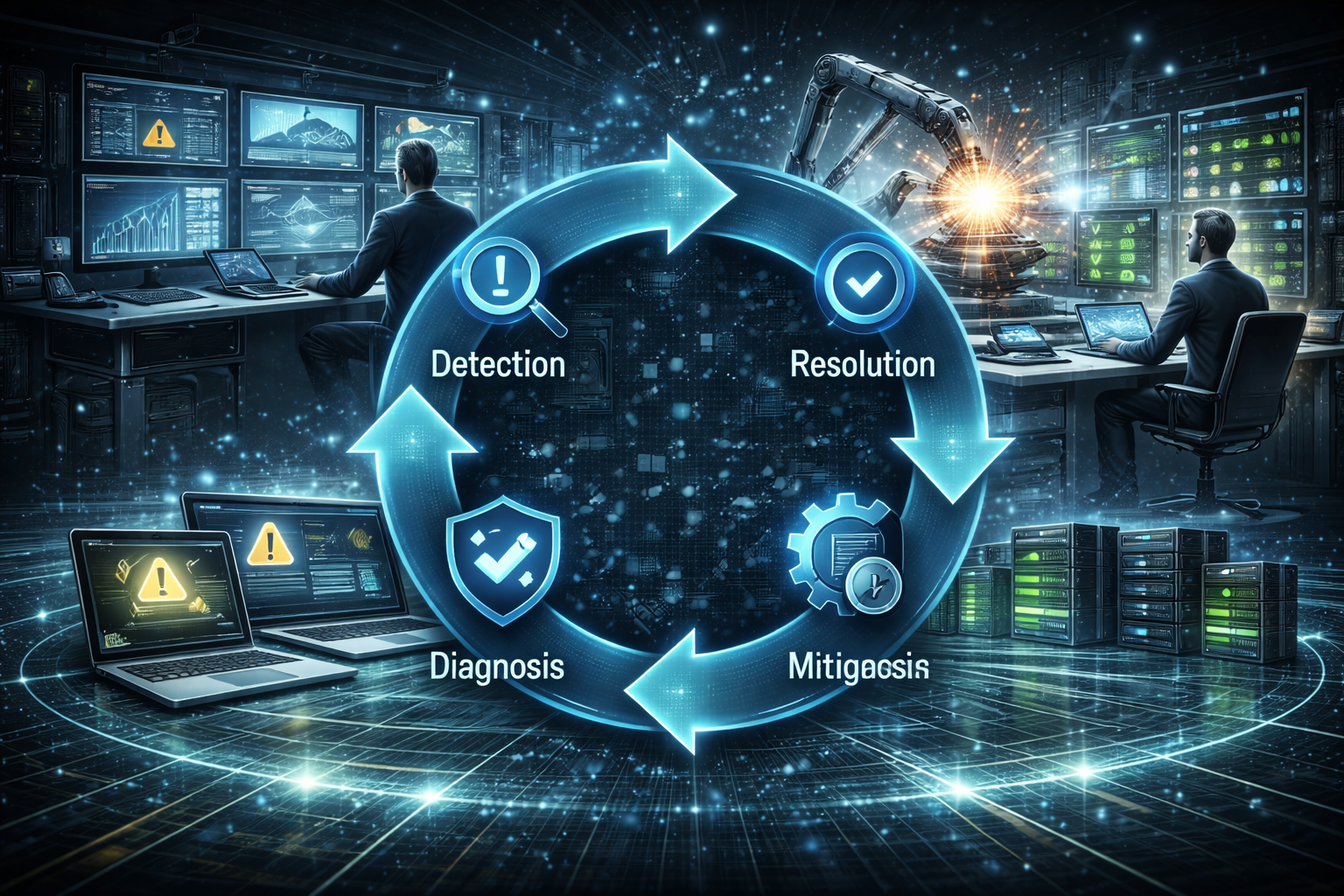
Incident Response Lifecycle - From Detection to Resolution

· 16 min read
Sanjoy Kumar Malik
Solution/Software Architect & Tech Evangelist
Incident Response Lifecycle - From Detection to Resolution

In the complex, interconnected world of modern software, failures are not a matter of if, but when. From a user’s perspective, a system that is down, slow, or incorrect is a broken system, regardless of the underlying technicality. The manner in which an organization responds to these inevitable disruptions directly impacts its reputation, user trust, and ultimately, its bottom line. Ad-hoc, chaotic incident response is a recipe for disaster, leading to prolonged outages, exhausted teams, and a continuous cycle of firefighting.

The true cost of unmanaged or ad-hoc incident response extends far beyond immediate revenue loss. It erodes customer loyalty, introduces significant security vulnerabilities, and degrades employee morale. When engineers are constantly reacting to emergencies without a clear process, they burn out, make more mistakes, and have less time for proactive development and innovation. Incident response, therefore, must be viewed not merely as a reaction to failure, but as a core reliability capability – a systematic, well-oiled machine designed to minimize impact and maximize learning.

At scale, a lifecycle view of incident response is not just beneficial; it’s essential. As systems grow in complexity and teams expand, a shared understanding of roles, processes, and expected behaviors becomes critical. A well-defined incident response lifecycle provides this framework, guiding teams from the first whisper of a problem to the final implementation of preventative measures. It transforms chaos into controlled action, enabling organizations to not only survive incidents but to emerge stronger and more resilient from each one.

Scope and Operating Context

Before diving into the mechanics, it is crucial to define what an "incident" truly means within your organization. Broadly, an incident is an unplanned interruption to a service or a reduction in the quality of a service. This includes events that are not yet impacting users but have the potential to, as well as events that compromise data integrity or security.